
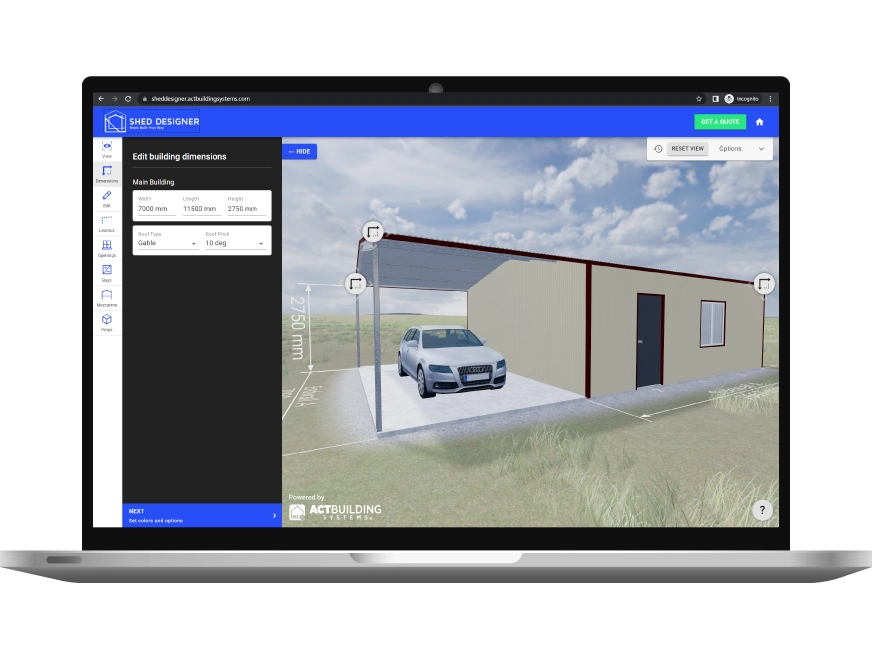
Design the ultimate caravan shed with shed designer.
Design a custom caravan shed online. Sized for pop-tops to 5th wheelers, BlueScope steel, ShedSafe accredited dealers, free comparable quotes.
Why choose Caravan Shed?
Australian BlueScope Steel
100% Australian-made steel in every building
ShedSafe Accredited
Only quotes from verified, accredited dealers
Fully Customisable
Change every dimension to suit your needs
Design Templates
Choose a design below to view details or start customising
No design templates available yet.
What is a caravan shed?
A caravan shed is a steel-framed Australian shed built around the dimensions of a parked recreational vehicle, with the door height, eave height and length to roll a tourer, a 5th wheeler or a toy hauler in and out without scraping the roof or jack-knifing on the drawbar. Different brief from a residential garage. The job here is clearance, drive-through height and a slab that does not pit under jockey wheels and corner stabilisers. Get those right and your van keeps its resale value through a decade of summers.
ShedDesigner's caravan shed templates run from a 9 by 4 metre single-bay garage for a 4.9 metre pop-top through a 12 by 5 metre single-bay for a 6.7 metre full-height tourer, and step up to a 14 by 6 metre 4.5 metre eave build for a 5th wheeler with the goose ladder still up. Each template uses 100% Australian-made BlueScope steel and Colorbond® cladding, engineered to AS/NZS 1170.2 wind loading for the actual region (Standards Australia, AS/NZS 1170.2:2021 Structural design actions, Part 2: Wind actions). Pick the closest template, set your dimensions, then submit your design once for free comparable quotes from ShedSafe accredited dealers in your region.
Sizing the shed by caravan length
Start with the van and work outwards. The Caravan Industry Association of Australia recorded a national fleet of more than 850,000 registered RVs in 2024, with the average new tourer running 5.8 to 6.7 metres in body length on the drawing board (Caravan Industry Association of Australia, State of the Industry Report 2024).
- Pop-top, 4.9 to 5.5 metre body. 9 by 4 metre internal floor, 3.0 metre eave is the working minimum. Add a 1.2 to 1.5 metre A-frame drawbar.
- Full-height tourer, 5.8 to 6.1 metre body. 10 by 4.5 metre internal, 3.3 metre eave, plus drawbar. The most common Australian build.
- Luxury tourer, 6.7 to 7.3 metre body. 12 by 5 metre internal, 3.6 metre eave. Twin axles, washing machine, ensuite, plus drawbar. Plan for a 600 to 800mm air-conditioner box on the roof.
- 5th wheeler or toy hauler, 7.6 metre plus body. 14 by 6 metre internal, 4.2 to 4.5 metre eave. The goose ladder, raised front bunk and ute deck push the door height past anything standard.
Add 800mm of standing room behind the rear bumper for accessing the spare wheel, and 600mm down each side for the awning arm and slide-out clearance.
Door height, drawbar and the antenna trap
The single most common caravan shed mistake is buying off van body height instead of true drive-through clearance.
A standard 6 metre tourer measures around 2.7 to 2.9 metres external height before you add the air-conditioner box (Jayco, Journey Outback specifications). The roller door drum sits about 400 to 600 mm above the daylight opening, so a 3.0 metre roller door in a 3.0 metre eave shed delivers around 2.4 metres of drive-through clearance. That is too tight for almost every full-height van.
The maths runs: van external height + air-con box (200 mm) + door drum (500 mm) + safety margin (200 mm) = the eave you actually need. For a 2.9 metre tourer, that is a 3.6 metre eave. Step to 4.2 metres for a 5th wheeler with the ladder still up.
Plan the door width too. A van runs 2.3 to 2.5 metres wide, plus mirrors. Fit a 3.6 metre wide roller door minimum to reverse in without clipping the sides. Wider for 5th wheelers towing a ute with bull bars.
Slab, power and security
Three trade-offs worth getting right at design time.
Slab vs gravel. A reinforced 125 mm slab to AS 2870 Residential slabs and footings is the long-term answer. The slab stops jockey wheels pitting, makes wash-down practical, and lets you bolt down a tool cabinet or a security bollard. Compacted road base is cheaper and drains, but it pits under corner stabilisers and traps the silicone seals under the van.
Power for AGM and house batteries. A 240 volt 15 amp outlet on a dedicated circuit lets you trickle-charge the house battery bank through the off-season. AGM and lithium banks both prefer a slow float charge over months of storage to long, deep recovery cycles in the season. An A-grade electrician sizes the rough-in to AS/NZS 3000:2018 Electrical installations (Wiring Rules) (Standards Australia) before the slab pour.
Security door and ventilation. A heavy-duty steel personal access door with a five-pin deadlock is the baseline. Two whirlybird vents stop the trapped Australian summer heat from drying out vinyl seals, decals and tyre walls.
Before you get quotes
A van is a $50,000 to $200,000 asset that lives outdoors most of its life. Putting a roof over it pays back through resale alone.
100% Australian-made BlueScope steel. Across structural framing and Colorbond® cladding. BlueScope's COLORBOND® steel cladding for sheds and garages carries a warranty of up to 15 years against corrosion to perforation, with the exact period set by location and application (BlueScope, Garages & Sheds Warranty). Check your build on BlueScope's online warranty estimator. The shed will outlast two upgrade cycles on the van.
ShedSafe accredited dealers, no exceptions. Every dealer on ShedDesigner is ShedSafe accredited under the Australian Steel Institute programme, which independently verifies dealer engineering against AS/NZS 1170.2 and the National Construction Code (Australian Steel Institute, ShedSafe Accreditation Programme).
Insurance and security upside. The Insurance Council of Australia's 2024 catastrophe report puts hail and storm at the top of motor insurance loss drivers, and Australian RV insurers (CIL, Ken Tame, NRMA) routinely reduce annual cost when a van is stored undercover and behind a locked door (CIL Insurance, Caravan insurance). Theft, hail and UV claims drop when the van lives inside.
One design, multiple quotes. Your design goes out to dealers covering your region. Every quote prices the same caravan shed, in the same steel, to the same engineering, to the same eave height, so the quotes you get back are directly comparable.
For lower-vehicle storage, see boat sheds. For a smaller motorhome footprint, see campervan shed. For a residential garage that fits one van alongside the cars, see triple garages. Browse the broader sheds category for related layouts.
Key Specs
Accreditations
1 Design
Multiple Shed Quotes
Submit your shed design and have multiple shed dealers quote for the best price.

1 Website
Unlimited Designs
From barns, garages, covers to 1, 2 or 3 vehicle garages the design options are limitless.
Frequently Asked Questions
What eave height do I need for a 6.7 metre full-height caravan?
A 6.7 metre full-height tourer measures around 2.9 metres external before the air-conditioner box, which adds another 200 mm. The roller door drum eats a further 400 to 600 mm above the daylight opening. Plan a 3.6 metre eave as the safe spec for a 6.7 metre tourer, and step to 4.2 metres if you are leaving the air-con box and roof solar in place. A 3.0 metre eave is too tight for any full-height van.
What is the minimum roller door height for a standard 6 metre caravan?
A 3.0 metre daylight roller door is the practical floor for a 6 metre tourer with a body height around 2.7 to 2.8 metres. Step to a 3.6 metre door for the same tourer with a roof air-conditioner, a roof box or solar panels in place. For a 5th wheeler with the goose ladder still up, fit a 3.6 to 4.2 metre door minimum. Always match door height to van plus accessories, not to van body alone.
Can my insurer reduce my annual cost when the caravan is stored undercover?
Many Australian RV insurers (CIL, Ken Tame, NRMA, Apia) treat secured undercover storage as a meaningful risk reduction and pass that through as a lower annual cost on hail, storm, theft and UV damage cover. Discounts are usually applied during quote rating against the storage address rather than as a flat percentage. Get a written quote with the shed flagged as "secured undercover" before you sign the build contract. The shed often pays itself back across the life of the policy.
Slab or compacted gravel under a caravan?
A reinforced 125 mm concrete slab to AS 2870 *Residential slabs and footings* is the long-term answer. Jockey wheels and corner stabilisers concentrate weight onto small contact patches and pit gravel within a season. The slab also makes wash-down practical and lets you bolt down a tool cabinet, a battery cabinet or a security bollard. Compacted road base is fine for a paddock shelter, not for a caravan shed.
Can I add power to charge the house batteries during off-season storage?
Yes. A 240 volt 15 amp outlet on a dedicated circuit, sized to AS/NZS 3000:2018 *Electrical installations (Wiring Rules)* by an A-grade electrician, lets you trickle-charge AGM and lithium house battery banks across the off-season. Run the supply trench from the meter at the same time as the slab is poured so the shed is wired once. A roof-mounted 1.5 to 2 kW solar panel through a maintainer charger is a popular off-grid alternative.
How do I stop condensation and heat damage in a caravan shed?
Two whirlybird vents at the ridge and a louvred or mesh-eave vent at the wall plate is the baseline ventilation spec. Trapped summer heat dries out vinyl seals, decals, tyre sidewalls and AGM batteries faster than open-sky storage. Insulated roof blanket at R3.0 to R3.5 keeps internal temperature swings below the daily peak by 8 to 12 degrees in inland Australia. The combination protects the rubber, the seals and the battery chemistry.
What security options work best for a caravan shed?
A heavy-duty steel personal access door with a five-pin deadlock and a roller door with a Lockwood-style internal slide bolt is the baseline. Step to motorised remote-control doors with rolling-code receivers for daily use. Floor-mounted ground anchors, a wheel clamp on the towball end and a battery-backed alarm with PIR sensors round out the spec for higher-value vans. The Insurance Council of Australia rates secured storage and visible deterrents as the two strongest anti-theft measures.
Do I need council approval for a caravan shed in rural Australia?
Often, no. In NSW rural zones (RU1 to RU6), a Class 10 farm building up to 200 square metres can qualify as exempt development under the State Environmental Planning Policy, provided setback, height and use conditions are met (NSW Department of Planning, *Outbuildings in rural areas*). Most caravan shed builds fall well under the 200 square metre cap. Residential blocks are tighter and almost always need a development application. Always confirm bushfire, flood and heritage overlays, which can override the exemption.
Other Shed designs
Garden Sheds
Custom garden sheds for suburban backyards. Sized to council exemption thresholds. ShedSafe accredited dealers, BlueScope steel.
Shed Kits
Custom shed kit, ShedSafe accredited and BlueScope steel. Site-engineered to AS/NZS 1170.2, kit or fully installed.
Skillion Roof Sheds
Modern single-slope skillion roof shed in Colorbond steel. Solar-ready, low-profile for height overlays, engineered to AS/NZS 1170.2.
Boat Sheds
Coastal boat shed sized for boat, trailer and outboard up. Marine-grade Colorbond, BlueScope steel, fully customisable.