
Design the ultimate farm shed with shed designer.
Design hay, machinery, dairy or general farm sheds online. Free quotes from ShedSafe accredited dealers using 100% Australian BlueScope steel.
Farm Designs
Hay Sheds
Tall open-front hay shed sized to your bales. Engineered to AS/NZS 1170.2, ATO fodder-storage eligible, ShedSafe accredited dealers.
Dairy Sheds
Dairy shed designs for milking operations. Customise layout and clearances for your herd size.
Machinery Sheds
Engineered cover for tractors, headers, sprayers and headers. Open-front or walled, BlueScope steel, fully customisable.
Rural Sheds
A general-purpose rural shed sized for hay, machinery, fencing, fertiliser and the workshop bay, in 100% Australian-made BlueScope steel.
Shearing Sheds
Built to AWI shearing shed design principles. Raised board, catching pens, wool room and grating storage, all in 100% Australian-made BlueScope steel.
Storage Sheds
General farm storage sized to your contents. Chemical, fertiliser, fodder or feed, engineered to AS/NZS 1170.2 in 100% Australian-made BlueScope steel.
Open Front Farm Sheds
Three-sided open front farm sheds. Wind-region engineered, BlueScope steel, ShedSafe accredited dealers, fully customisable.
Open Gable Farm Sheds
Drive-through open gable farm shed for hay, grain or machinery. Engineered to AS/NZS 1170.2, ATO fodder-storage eligible, ShedSafe accredited dealers.
Grain Storage Sheds
Concrete-panel grain sheds sized by tonnes and bay count. BlueScope steel, ShedSafe accredited dealers, designed for harvest peak.
Cattle Yard Cover
Open-sided cover sized to your existing race and crush. Cool-roof Colorbond®, ShedSafe accredited dealers, BlueScope steel.
What is a farm shed?
A farm shed is a steel-framed Australian rural building used to house machinery, hay, livestock, fertiliser or stock feed. Most are built from 100% Australian-made BlueScope steel, clad in Colorbond®, and engineered to AS/NZS 1170.2 wind loading for the paddock they sit on. The shape changes with the job. Open-front machinery sheds, tall hay sheds with high airflow, walled dairy sheds with a hardstand floor, and general-purpose farm sheds that mix all three.
ShedDesigner covers the lot. Pick the closest template, set your span, length, eave height and bays, drop in roller doors and lean-tos where you need them, then submit your design once for free comparable quotes from ShedSafe accredited dealers in your region.
Choosing the right farm shed
Most farm shed buyers walk in with a job in mind, not a style. Here is how the main types tend to land.
Hay sheds
Tall, open-fronted, built to load round bales fast and keep airflow moving so the stack does not spoil. Start with a high-eave open-bay template, set the span wide enough for two rows of bales plus tractor clearance, and keep at least one long side open. The mistake first-time buyers make is undersizing the eaves. If your tractor cannot back in with the loader raised, the shed costs you minutes every day.
Machinery sheds
The workhorse of the rural fleet. Walls on the prevailing weather side, open access on the lee side, eave height set to clear the tallest cab plus aerials. Headers, balers, tractors with cabs and forklifts each push the height up. Start with a tall machinery template, then push the eave to suit your biggest piece of gear, not your average.
Dairy sheds
Walled, washable, drained. Concrete slab as standard, smooth-finish cladding for hose-down hygiene, gutters and downpipes sized for southern winter rain. Start with a fully enclosed template, lock in slab thickness with your dealer, and treat ventilation as a welfare line item, not an afterthought.
General-purpose farm sheds
The most common buy. Mixed use across machinery, hay, workshop and storage. Walled on two or three sides, lean-tos for cover, a roller door for the workshop bay, an open bay for hay or vehicles. Start with a generic farm template and let the configurator flex the bays.
Calving and lambing shelters
Lighter structures, often three-sided, sited near the home paddock. Lower clearance, simpler engineering, faster to put up. Worth pricing as a second build alongside your main shed. Many buyers add one once the main quote is in their hands.
If you are still on the fence, pick the closest template, jump into the designer, and see how it looks at your dimensions. You can always switch templates without losing your specs.
Span, slab and engineering essentials
Three numbers decide what your farm shed costs and how long it stands.
Wind region. Most rural Australian sites sit in AS/NZS 1170.2 Region A or Region B. Inland NSW, Victoria and SA sit largely in Region A. Coastal NSW north of Newcastle, the Queensland coast and the Top End cross into Region B and C, where the standard now splits B into B1 and B2. Higher region equals heavier sections, deeper footings and tighter bay spacing. Your dealer engineers to the actual region for your block, not a national average.
Clear span. Most farm shed buyers land between 12 and 24 metres of clear span without internal columns. Larger spans up to 30 metres are routine for hay and machinery sheds with the right portal frame. Past that, custom engineering review kicks in.
Slab versus piers. Walled farm sheds get a concrete slab as standard, sized by your dealer for the wind uplift and lateral loads in your engineering. Open hay and machinery sheds can sit on engineered piers or compacted hardstand. Cheaper to start, faster to put up, and fine for the job. Decide at quote stage, not after.
Before you get quotes
A farm shed typically stays in service for 30 years or more, so the specification behind each quote matters as much as the price on it. Four things worth checking before quotes go out.
Steel and cladding. Structural framing and Colorbond® cladding are made from 100% Australian-made BlueScope steel. BlueScope's COLORBOND® steel cladding for sheds and garages carries a warranty of up to 15 years against corrosion to perforation, with the exact period set by location and application (BlueScope, Garages & Sheds Warranty). Check your build on BlueScope's online warranty estimator. Coastal sites within 1km of a marine environment are assessed separately.
Dealer accreditation. Every dealer on ShedDesigner is ShedSafe accredited under the Australian Steel Institute programme, which independently assesses dealer design and engineering against the National Construction Code and AS/NZS 1170.2 wind loading.
One design, multiple quotes. Your design goes out to dealers who cover your region. Every dealer prices the same shed, in the same steel, to the same engineering, so the quotes you get back are directly comparable.
Local dealers. Quotes come from dealers based in your region who can assess the actual site conditions.
Tax and council framing
Two numbers worth knowing before you sign.
Instant asset write-off. The $20,000 instant asset write-off applied through to 30 June 2026 for eligible small businesses with aggregated turnover under $10 million, and the Federal Government has announced the threshold will become permanent from 1 July 2026, though this was not yet law at the time of writing (Australian Taxation Office, $20,000 instant asset write-off for 2025-26, 2025). Check ato.gov.au for the current status. Hay sheds, grain storage and silos may also qualify under separate fodder storage rules. Talk to your accountant about which framework fits your build.
Council approval. In NSW rural zones (RU1 to RU6), farm buildings up to 200 square metres can qualify as exempt development under the State Environmental Planning Policy, provided setback, height and use conditions are met (NSW Department of Planning, Outbuildings in Rural Areas guidance). Other states differ. Victoria's Farming Zone, SA's primary production zones and WA's rural zones each carry their own thresholds. Dealer quotes include engineering documentation that supports the approval pathway in your council area.
Key Specs
Accreditations
Simple process to start
Select Your Starting Template
Choose from one of our starting design templates or start from scratch with our custom template.
Customise Your Shed Design
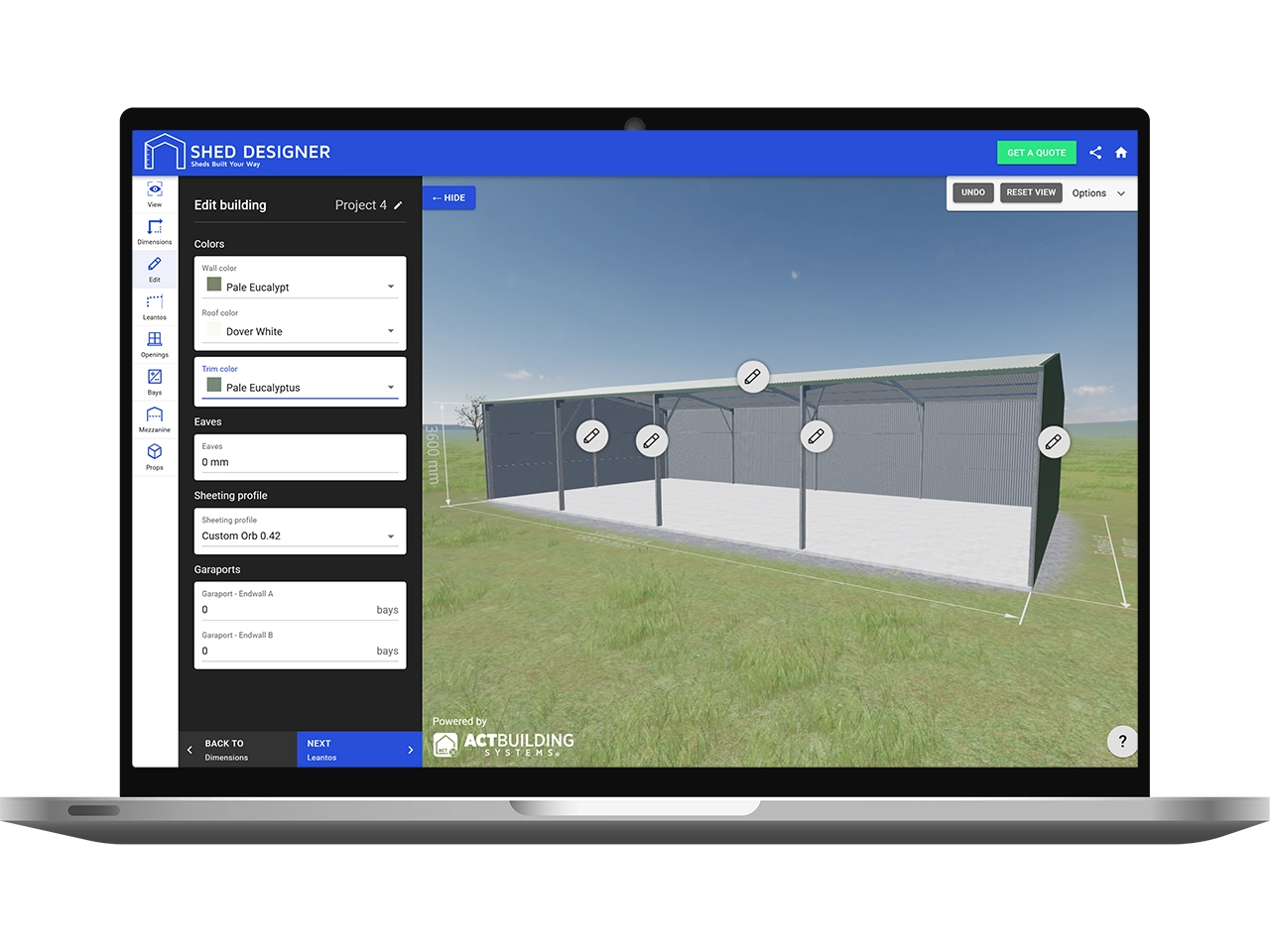
Change the height, width or length of your building. Add a lean-to or internal walls or add accessories.
Hit The Quote Button
When you have finished with your design submit it for quoting from our shed supply partners.
1 Design
Multiple Shed Quotes
Submit your shed design and have multiple shed dealers quote for the best price.

1 Website
Unlimited Designs
From barns, garages, covers to 1, 2 or 3 vehicle garages the design options are limitless.
Frequently Asked Questions
How much does a farm shed cost in Australia?
Most farm shed builds in Australia sit between $30,000 and $250,000 plus, depending on type, span, fit-out and wind region. Hay and machinery sheds tend to run $150 to $250 per square metre, dairy and grain sheds run higher because of the slab, walls and drainage.
What is the difference between a hay shed and a machinery shed?
A hay shed is usually open-fronted with high eaves and a wide span, built to load round bales fast and keep airflow moving so the stack does not heat or spoil. A machinery shed has walls on the prevailing weather side, eave heights set to clear cabs and aerials, and roller doors for security. Most farms run both. Many buyers price them as separate builds so they can stage the work.
What is the maximum span for a custom farm shed?
Most farm shed buyers land between 12 and 24 metres of clear span without internal columns. Spans up to 30 metres are routine for hay and machinery sheds with engineered portal frames. Larger spans are possible with a custom engineering review. The 3D designer flags when your dimensions cross the standard envelope and need a custom check before quoting.
Can I claim a farm shed on the instant asset write-off?
Possibly. The $20,000 instant asset write-off for eligible small businesses with aggregated turnover under $10 million applied through to 30 June 2026, and the Federal Government has announced the threshold will become permanent from 1 July 2026, though this was not yet law at the time of writing. Check ato.gov.au for the current status. Some farm sheds also qualify under the fodder storage asset rules, which allow full deduction in the year of purchase regardless of cost. Talk to your accountant before submitting your quote so you can time the install to suit your tax year.
Do I need council approval for a farm shed in NSW?
Often, no. In rural zones RU1 to RU6, a farm building up to 200 square metres can qualify as exempt development under the NSW State Environmental Planning Policy, provided setback, height and use conditions are met. Larger farm sheds, structures with habitable space, and sheds in environmental or heritage overlays still need development approval. Always check with your local council before pouring the slab. Other states have their own thresholds.
Does my farm shed need a concrete slab?
It depends on the type. Walled and dairy sheds get a slab as standard, sized to the engineering for wind uplift and lateral loads in your region. Open hay sheds and machinery covers can be built on engineered piers or compacted hardstand, which is cheaper and faster. Your dealer prices both options into the quote so you can compare without re-specifying.
Will a farm shed handle our wind region?
Yes, when it is engineered for the actual region. AS/NZS 1170.2 splits Australia into Regions A through D, with Region B further split into B1 and B2. Higher region equals heavier sections, deeper footings and tighter bay spacing. Check that each quote is engineered to the wind region of your specific block, not a generic national rating.
How long does a Colorbond® farm shed last?
BlueScope's COLORBOND® steel cladding for sheds and garages carries a warranty of up to 15 years against corrosion to perforation, with the exact period set by location and application (BlueScope, *Garages & Sheds Warranty*). Check your build on BlueScope's online warranty estimator. With normal maintenance (a six-monthly fresh-water wash on areas not normally rained on), Colorbond® farm sheds routinely stay sound well past the warranty period. Sites within a kilometre of the coast or near salty bores get assessed separately at quote stage.