
Design your solar-ready shed with shed designer.
Design a solar-ready shed online. Purlin spacing, pitch, orientation engineered for PV. BlueScope steel, ShedSafe dealers, free comparable quotes.
Why choose Sheds with Solar?
Australian BlueScope Steel
100% Australian-made steel in every building
ShedSafe Accredited
Only quotes from verified, accredited dealers
Fully Customisable
Change every dimension to suit your needs
Design Templates
Choose a design below to view details or start customising
No design templates available yet.
What is a solar-ready shed?
A solar-ready shed is a steel-framed building designed up-front to host a photovoltaic array on the roof, not retrofitted to it after the fact. The buyer is putting PV on the roof to power the shed itself, feed the house under a net meter, charge an EV, run a workshop, or back up a rural property with batteries. Most are clad in Colorbond® and built from 100% Australian-made BlueScope steel, engineered to AS/NZS 1170.2:2021 wind loading for the actual region (Standards Australia, AS/NZS 1170.2:2021 Structural design actions, Part 2: Wind actions), with the array load and added cross-section accounted for in the design. Where a generic shed becomes a solar shed by bolting rails on later, a solar-ready shed gets heavier purlins, pre-routed conduit, junction-ready brackets and a roof shape chosen for the array.
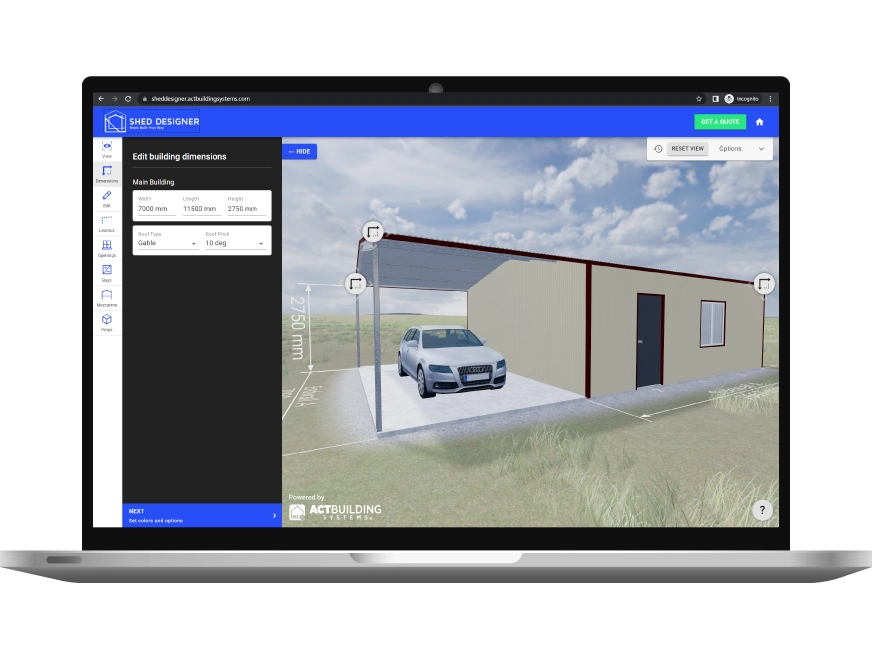
ShedDesigner's solar-ready templates span the shed designs range from 6 by 9 metres up to 18 by 30 metres. Pick the closest template, set your span, length, eave height, pitch and roof shape, then submit your design once for free comparable quotes from ShedSafe accredited dealers in your region.
Roof shape, pitch and orientation for solar
Three decisions that set the array yield before a single panel goes up.
Roof shape. A skillion roof gives one uninterrupted plane, ideal for a single large array facing north. See skillion roof sheds for the full skillion comparison. A gable roof gives two planes, which lets you split an array east-west across both faces, or run a north-facing array on one slope and leave the south face for daylight only. See gable roof sheds for the gable comparison.
Pitch. A 10° to 30° roof pitch is the practical PV range across most of Australia, with 20° to 30° at the optimal end for fixed-tilt arrays at southern latitudes (Clean Energy Council, Design Guidelines for Grid-Connected Solar PV Systems). A 10° pitch hits the minimum for most LYSAGHT® steel roofing profiles per BlueScope's installation manual and is acceptable for solar provided the panels carry adequate self-cleaning rainfall.
Orientation. True north (0° azimuth) maximises annual yield. East-west splits typically deliver 80% or more of north-facing yield, often with a flatter daily generation curve, which suits households on time-of-use tariffs (Clean Energy Council guidance). Confirm the roof orientation against your block before you lock the template.
Engineering: purlins, wind uplift and AS/NZS 5033
A retrofit array sits on whatever the original shed had. A solar-ready shed gets the structure designed for it.
Purlin spacing for PV rail systems. Most rail systems clamp on standard C or Z purlins at 900 to 1,200 mm centres, but heavier 600 mm to 900 mm centres simplify the rail layout and reduce span deflection under wind uplift. ShedDesigner templates carry the closer purlin spacing where the buyer flags solar at design time.
Wind uplift with the array on. The added cross-section of a PV array changes the wind load path on the roof. AS/NZS 1170.2:2021 covers the engineering principles (Standards Australia). Cyclonic Region C and D blocks need extra attention because uplift coefficients on the array edges are higher than the bare roof.
AS/NZS 5033 array installation. All grid and stand-alone PV arrays in Australia install to AS/NZS 5033:2021 Installation and safety requirements for photovoltaic (PV) arrays (Standards Australia). The standard covers DC isolators, earthing, cable separation and array labelling.
AS/NZS 4777.1 inverter grid connection. Grid-tied inverters install under AS/NZS 4777.1:2016 Grid connection of energy systems via inverters (Standards Australia), which sets the requirements for connection to the distribution network.
Power use cases: shed only, net meter, EV, off-grid
Four common scenarios, four different sizing decisions.
- Shed only. A small 3 to 5 kW array runs lights, power tools, a fridge and a small compressor with a 5 to 10 kWh battery for after-dark work.
- Net meter back to house. A 6.6 to 13.2 kW array on the shed roof feeds the house under the same NMI, exporting surplus to the grid under AS/NZS 4777.1.
- EV charger from the array. A 7 kW Level 2 EV charger pairs naturally with a 10 to 13 kW array and a 10 to 20 kWh battery for charging from stored solar overnight.
- Off-grid with batteries. A rural shed runs fully off-grid on a 10 to 20 kW array and a 20 to 40 kWh battery bank, often with a backup generator. See rural sheds for the rural off-grid angle and class 1a liveable sheds for the off-grid liveable angle.
CEC accredited installer and the STC rebate
The federal Small-scale Renewable Energy Scheme (SRES) issues Small-scale Technology Certificates (STCs) on installations of solar PV up to 100 kW. The STC rebate is the gate that brings residential PV pricing within reach. To claim STCs, the system must be designed and installed by a Clean Energy Council (CEC) accredited installer (Clean Energy Regulator, Small-scale Renewable Energy Scheme). Larger commercial arrays above 100 kW move to the Large-scale Renewable Energy Target framework. See large sheds for commercial PV at scale.
Before you get quotes
A solar array sits on the roof for 25 to 30 years. The shed underneath needs to outlast it.
100% Australian-made BlueScope steel. Across structural framing and Colorbond® cladding. BlueScope's COLORBOND® steel cladding for sheds and garages carries a warranty of up to 15 years against corrosion to perforation, with the exact period set by location and application (BlueScope, Garages & Sheds Warranty). Check your build on BlueScope's online warranty estimator.
ShedSafe accredited dealers, no exceptions. Every dealer on ShedDesigner is ShedSafe accredited under the Australian Steel Institute programme, which independently verifies dealer engineering against AS/NZS 1170.2 and the National Construction Code.
One design, multiple quotes. Your design goes out to dealers covering your region. Every quote prices the same solar-ready shed, in the same steel, to the same engineering, to the same purlin spacing and conduit rough-in, so the quotes you get back are directly comparable.
Browse the broader shed designs category for related layouts.
Key Specs
Accreditations
1 Design
Multiple Shed Quotes
Submit your shed design and have multiple shed dealers quote for the best price.

1 Website
Unlimited Designs
From barns, garages, covers to 1, 2 or 3 vehicle garages the design options are limitless.
Frequently Asked Questions
How many kW of solar can I fit on a 6×9, 9×12 or 12×18 metre shed roof?
A 6 by 9 metre shed roof gives roughly 54 square metres of usable plane, which fits about 5 to 6 kW of standard 440 W panels (around 12 to 14 panels). A 9 by 12 metre roof fits about 12 to 15 kW (28 to 34 panels). A 12 by 18 metre roof fits about 25 to 30 kW (60 to 70 panels). Yields depend on orientation, pitch, shading and panel layout. Confirm with a CEC accredited designer against the actual roof plan.
How much does north versus east-west orientation cost in efficiency?
True north (0° azimuth) is the optimum for fixed-tilt arrays in Australia and delivers 100% of reference yield. An east-west split typically delivers 80% or more of north-facing yield, often with a flatter daily generation curve that better matches morning and evening load (Clean Energy Council guidance). For households on time-of-use tariffs or self-consumption, east-west often beats pure north on dollar terms even at slightly lower kWh.
Off-grid versus grid-tied versus hybrid: which suits a shed?
Grid-tied is the cheapest per kWh and exports surplus to the grid under AS/NZS 4777.1:2016. Off-grid runs fully on battery and a backup generator, and suits rural blocks where grid connection costs more than $30,000 to bring in. Hybrid combines battery storage with a grid connection, exports when the battery is full, and rides through outages. Most net-meter shed installs land on hybrid for the resilience.
What size battery do I need for a shed-only versus a whole-property setup?
A shed-only setup with lights, a fridge and occasional power tools runs comfortably on a 5 to 10 kWh battery for overnight use. A whole-property hybrid with the shed array feeding the house typically pairs a 10 to 20 kW array with a 10 to 20 kWh battery for daily cycling. A fully off-grid rural setup usually runs a 20 to 40 kWh bank to cover three to five cloudy days. Battery sizing should match the deepest expected daily load, not just average use.
Am I eligible for the STC rebate on a solar shed?
Yes, provided the system is up to 100 kW, the array meets AS/NZS 5033:2021, the inverter is on the CEC approved list, and the install is signed off by a CEC accredited installer (Clean Energy Regulator, *Small-scale Renewable Energy Scheme*). The number of certificates depends on system size, location zone (1 through 4) and the year of install, since STCs deem forward to 2030.
Can I add solar to my shed later, or do I have to design for it now?
You can retrofit solar to almost any steel shed roof, but designing for it up-front saves cost and rework. Solar-ready ShedDesigner templates carry tighter purlin spacing for PV rail clamps, pre-routed conduit from the roof to the switchboard location, a roof shape chosen for the array (skillion or gable), and the array's added wind uplift accounted for under AS/NZS 1170.2:2021. Retrofitting can mean adding purlins, drilling new penetrations and re-engineering for the load.
Do I need a CEC accredited installer for a shed solar install?
Yes, if you want to claim the federal STC rebate. The Clean Energy Council accredits installers under the Solar PV Install scheme, and the Clean Energy Regulator requires a CEC accredited installer's signature on the certificate of compliance for STC eligibility. CEC accreditation is also the consumer trust mark recognised by most state and territory rebate schemes.
Can I run an EV charger off my shed solar array?
Yes. A 7 kW Level 2 EV charger pairs naturally with a 10 to 13 kW array and a 10 to 20 kWh battery, which lets you charge an EV from stored solar overnight. The charger installs under AS/NZS 3000:2018 *Wiring Rules* and AS/NZS 4777.1:2016 (Standards Australia). Smart chargers can be set to charge only from surplus solar, prioritise the battery, or pull from the grid when needed.
Other Shed designs
Garden Sheds
Custom garden sheds for suburban backyards. Sized to council exemption thresholds. ShedSafe accredited dealers, BlueScope steel.
Shed Kits
Custom shed kit, ShedSafe accredited and BlueScope steel. Site-engineered to AS/NZS 1170.2, kit or fully installed.
Skillion Roof Sheds
Modern single-slope skillion roof shed in Colorbond steel. Solar-ready, low-profile for height overlays, engineered to AS/NZS 1170.2.
Boat Sheds
Coastal boat shed sized for boat, trailer and outboard up. Marine-grade Colorbond, BlueScope steel, fully customisable.